

 That machine didn’t fail because of bad luck. It failed because someone ignored the small stuff for eighteen months, and the valve finally decided to make them pay for it. I’ve walked into too many plants where a $400 valve turned into a $40,000 production stoppage, and every single time, the operator on shift said the same thing: “It was running fine yesterday.” It was not running fine. It was running on borrowed time.
So let’s talk about what actually keeps a hydraulic valve control system alive, without the textbook fluff.
First, understand what you’re dealing with. A hydraulic valve control system is not just a block of metal with a spool inside. It is a precision instrument that lives in a hostile environment. Contamination, heat, pressure spikes, and dirty fluid are all trying to kill it every hour of every shift. Your job is not to be a hero who rebuilds it after a failure. Your job is to make sure the failure never gets the chance.
The number one killer is contamination. Not the big chunks you can see. I’m talking about particles smaller than a grain of talc, floating in your oil, acting like liquid sandpaper on every spool land and bore. A single gram of dirt in a 200-liter reservoir can destroy a valve in weeks. This is why filter maintenance is not optional. Check your return-line filters and pressure filters on a fixed schedule, not when the clog indicator pops. That indicator is a last warning, not a maintenance trigger. If you wait for it, you have already been circulating abrasive fluid through your valves for days.
Here is a habit worth building. Every Monday morning, before the first shift starts, pull a fluid sample from the reservoir and look at it against a white background. Not a lab test. Just your eyes. If it looks cloudy, you have water or air entrainment. If it smells burnt, you have heat damage. If it feels gritty between your fingers, you have a contamination problem that is already eating your valve spools. Ten seconds of this beats a hundred pages of diagnostic data.
Now, about those spools. The clearance between a spool and its bore is measured in microns. That is roughly the thickness of a human hair split twenty times. When a spool starts sticking, you will feel it before you see it. The machine will hesitate. The actuator will drift. The pressure gauge will twitch instead of holding steady. This is the moment to act, not after the valve seizes completely and you are pulling it out with a crane.
Sticking spools usually come down to three things: varnish from overheated oil, contamination wedged in the clearance, or a bent stem from a pressure spike. Varnish is the sneaky one. It builds up slowly, like cholesterol in an artery, and one day the spool just cannot move. The fix is not to crank up the pilot pressure. The fix is to keep your oil temperature in the range your valve manufacturer specified, usually between 40 and 55 degrees Celsius. Run it hotter and you cook the oil. Run it colder and you get sluggish response and cavitation. Both destroy valves.
Let’s talk about the electrical side, because this is where a lot of operators get caught out. A solenoid that is not receiving full voltage will still click. It will still make noise. But it will not shift the spool all the way, and you end up with a valve that is half-open, generating heat and contaminating your fluid with burnt insulation particles. Check your coil voltage under load, not just at rest. A coil that reads 24 volts when idle can drop to 18 volts when the machine is working, and that is enough to cause partial shifting. If you see a voltage drop, find the corroded connector or the undersized wire. Do not just replace the coil and hope.
Pressure settings matter more than most people admit. Every valve has a pressure rating, and every system has a relief setting. When someone decides to “get a little more power” by cranking up the relief valve, they are not getting more power. They are buying a future failure. Overpressure flexes the valve body, distorts the spool bore, and shortens seal life. If a machine is losing force, find out why. Do not just raise the pressure and walk away. That is not maintenance. That is sabotage with a wrench.
Here is a practical routine that works in real plants, not just in theory.
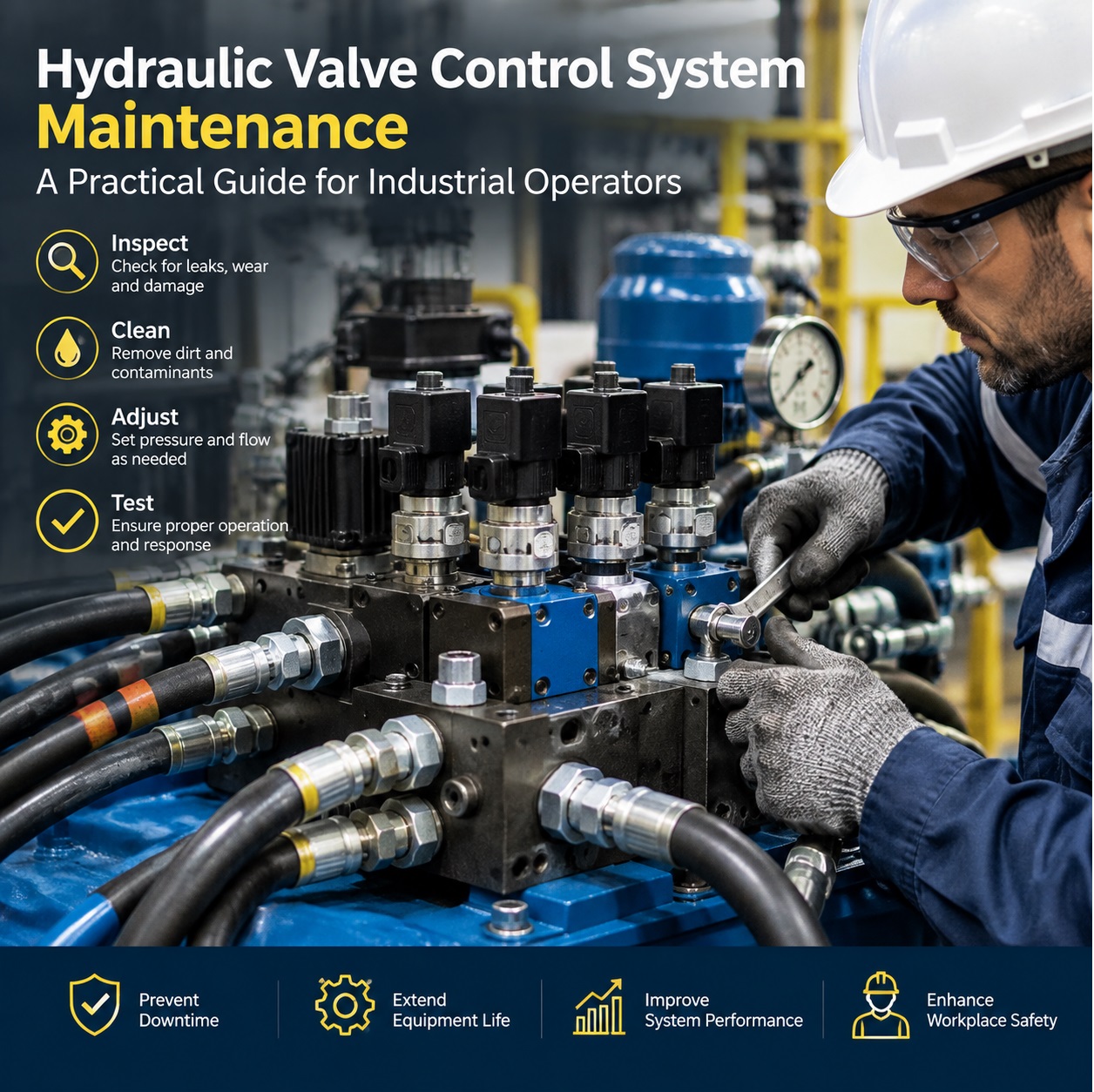
Daily, do a walk-around. Listen to the system. A healthy hydraulic valve sounds like a steady hum. A failing one clicks, chatters, or whines. Touch the valve body if it is safe. It should be warm, not hot. Check for external leaks at the end caps and fittings. A single drop per minute is not “normal seepage.” It is a warning.
Weekly, check your filter indicators and drain any water from the reservoir. Water is heavier than oil, so it settles at the bottom. A quick bleed from the drain valve at the lowest point can remove a surprising amount of trouble.
Monthly, pull a fluid sample and send it for particle counting. You want to know your ISO cleanliness code. If it is drifting upward, find the source. It might be a failing breather, a torn wiper seal on a cylinder, or a return line that is dumping fluid back into the tank without filtration.
Annually, or every 2,000 hours, whichever comes first, remove and inspect your critical valves. Not all of them. Just the ones that control your most important functions. Look at the spool for scoring. Look at the seals for hardening or cracking. Look at the bore for varnish. If you catch these things early, a cleaning and seal kit costs a few hundred dollars. A new valve costs a few thousand. A production stoppage costs whatever your worst hour is worth.
One more thing. Document everything. Not because your manager wants paperwork, but because patterns reveal themselves over time. If you notice that the same valve fails every eight months, you do not have a valve problem. You have a system problem. Maybe it is heat. Maybe it is contamination from a specific actuator. Maybe it is a pressure spike when another function engages. Without records, you are just guessing. With records, you are diagnosing.
The truth is, hydraulic valve control systems are not fragile. They are actually incredibly robust. But they are also unforgiving. They do not tolerate neglect, and they do not give second chances once a spool seizes or a bore is scored. The operators who keep their machines running for decades are not the ones who know how to rebuild a valve. They are the ones who never have to. They keep the oil clean, the temperature steady, the pressure honest, and the electrical signal strong. That is the whole secret. Everything else is just details.
So next time you walk past a hydraulic power unit and hear that steady, quiet hum, take a second to appreciate it. That hum is not luck. That hum is maintenance done right.