

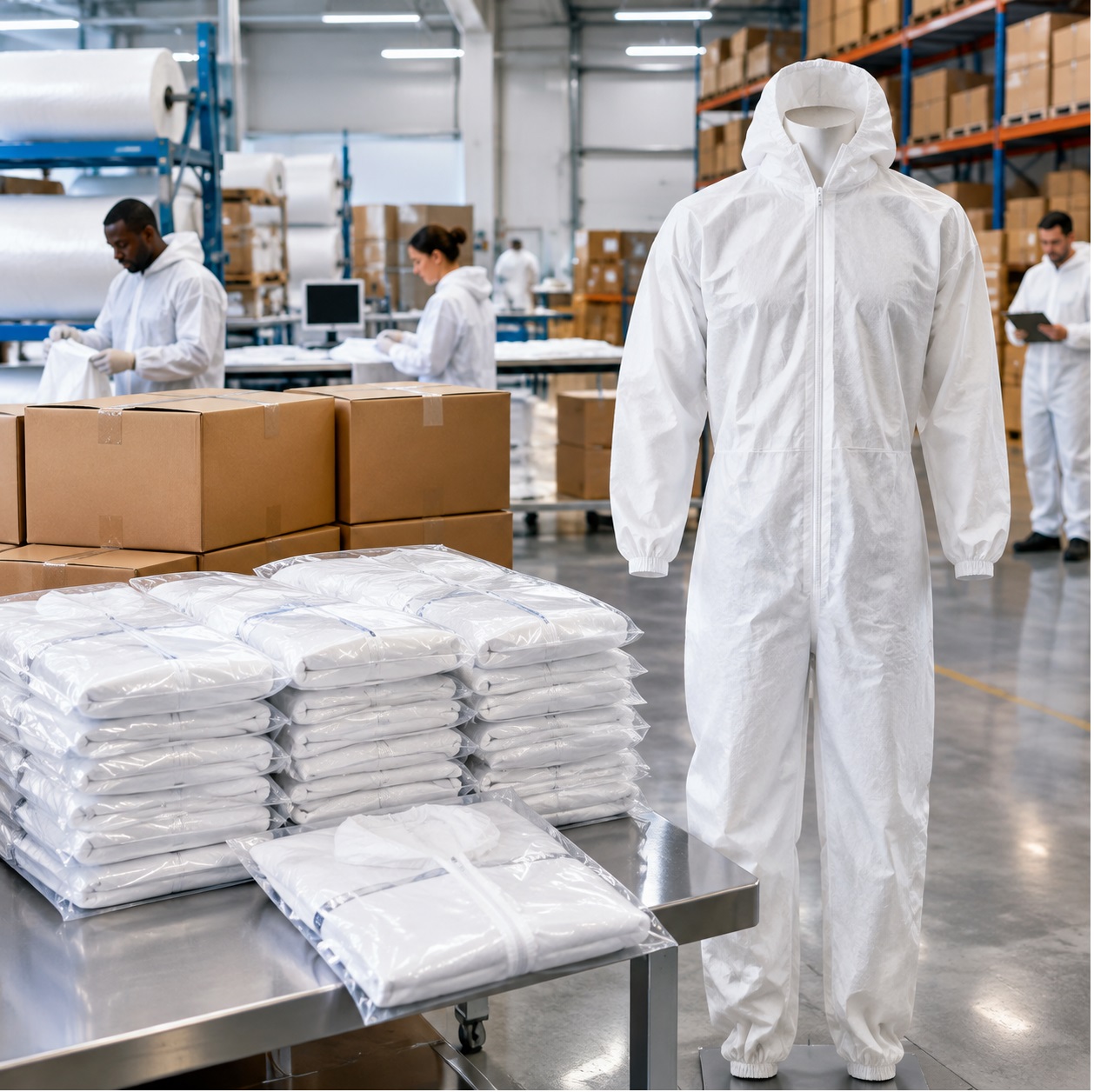
 Your last bulk order of coveralls probably looked fine on the invoice. The trouble showed up three weeks later, when zippers started popping mid-shift and half the crew was standing around in split seams and bad moods.
That’s the thing about disposable coveralls. They’re cheap enough that nobody fights over the purchase order, and important enough that a bad batch can shut down a paint line, contaminate a cleanroom, or send someone home with chemical burns. So the question isn’t really “where do I buy these things.” It’s “who do I trust with a container load.”
Let me save you a few expensive lessons.
First, understand what you’re actually shopping for. “Disposable coverall” covers everything from a 35 GSM polypropylene sack with a zipper to a microporous film suit with taped seams that passes Type 5 and Type 6 testing. Those are not the same product, and the price gap between them is enormous. If your supplier quotes you one number without asking what you need it for, they’re either guessing or hoping you don’t know the difference.
The materials, roughly, in order of protection and cost:
– PP nonwoven: breathable, cheap, good for dust and light dirt. Not much of a liquid barrier. – SMS (spunbond-meltblown-spunbond): better particle and splash resistance while staying breathable. The workhorse for most industrial and medical buyers. – Microporous film laminated to nonwoven: liquid-tight, often used for Type 5/6 suits and chemical handling. Less breathable, more protective.
Seams matter as much as fabric. Serged seams are the budget option. Bound or taped seams cost more and are what you want if there’s any chance of liquid exposure. Ask specifically. A lot of suppliers will quote serged and let you assume taped.
Now the actual sourcing part.
Alibaba, Made-in-China, and the various B2B marketplaces are full of “manufacturers” that are really trading companies with a nice website and a warehouse. That’s not automatically a scam, but you’re paying a markup for someone to forward your email to a factory. Fifteen to thirty percent, typically. Sometimes more.
So how do you tell the difference? Ask for the factory address and then look it up on a satellite map. Ask for a business license and check that the registered scope includes manufacturing, not just “trading” or “import and export.” Ask for video of the production line, filmed that day, with something showing the date. A real factory will send it within a day. A trading company will send you a stock clip from 2019 or stall.
Capacity questions separate the real players too. How many coveralls can you produce per month in this specific style? What’s your current lead time on a 20-foot container? Who are three current bulk customers I can call? If they can’t answer those without a week of “let me check with my manager,” walk away.
Certifications are non-negotiable depending on your market:
– CE marking with the right category for Europe. – Type 5 (EN 13982-1) for hazardous dry particles. – Type 6 (EN 13034) for limited liquid chemical splash. – EN 14126 if there’s any biological hazard involved. – ISO 9001 for general quality systems, ISO 13485 if the product is going into medical channels.
Ask for the actual test reports, not just a logo on a brochure. Certificates get borrowed, copied, and expired. Check the certificate number against the issuing body’s database. It takes five minutes.
Then there’s the price trap. If a quote comes in 30 percent under everyone else, something is off. Usually it’s the fabric weight. A supplier says “40 GSM” and ships 32 GSM, and unless you’re weighing the suits yourself, you might not notice until they tear. Which is why you should order pre-production samples, cut one open, and weigh a square meter on a kitchen scale. It sounds obsessive. It’s also the fastest way to catch a liar.
Red flags worth taking seriously:
– No physical factory address, or an address that turns out to be a residential building. – Refusal to allow third-party inspection (SGS, Bureau Veritas, TÜV). Buyers who inspect are buyers who find problems. – Vague answers about GSM, seam type, or packaging specs. – Pressure to pay by wire to a personal account. – A “factory tour” that’s just a showroom and a conference room.
Once you’ve narrowed it down, negotiate the boring stuff in writing. MOQ, lead time, packaging (how many pieces per polybag, per carton), carton dimensions, and how many cartons fit in a 20-foot versus 40HQ container. A 20-footer usually holds somewhere in the range of 15,000 to 17,000 coveralls depending on size and packing; a 40HQ roughly doubles that. Get the exact number from your supplier before you book freight, because guessing wrong on cube is an expensive hobby.
Payment terms: 30 percent deposit, 70 percent against the bill of lading copy is standard. If you’re ordering serious volume, use a letter of credit or a platform with trade assurance. Never pay 100 percent upfront to a supplier you haven’t vetted.
The suppliers worth keeping are the ones that make this easy. They send samples without a fight. They answer technical questions with technical answers. They invite you to audit. They tell you when a style isn’t right for your application instead of selling you whatever’s in stock.
That last one is the real signal. A manufacturer who talks you out of a sale because the product doesn’t fit your hazard profile is a manufacturer who’ll still be around when you reorder.
So before you wire that deposit, get a sample, weigh the fabric, test the zipper, check the certificates, and ask the factory to show you its production floor live. Do that, and your next container load won’t end with a crew standing around in ripped suits, wondering who approved the purchase